
GameBooks Empire Review
A New AI System For Children’s Gamebook Creators
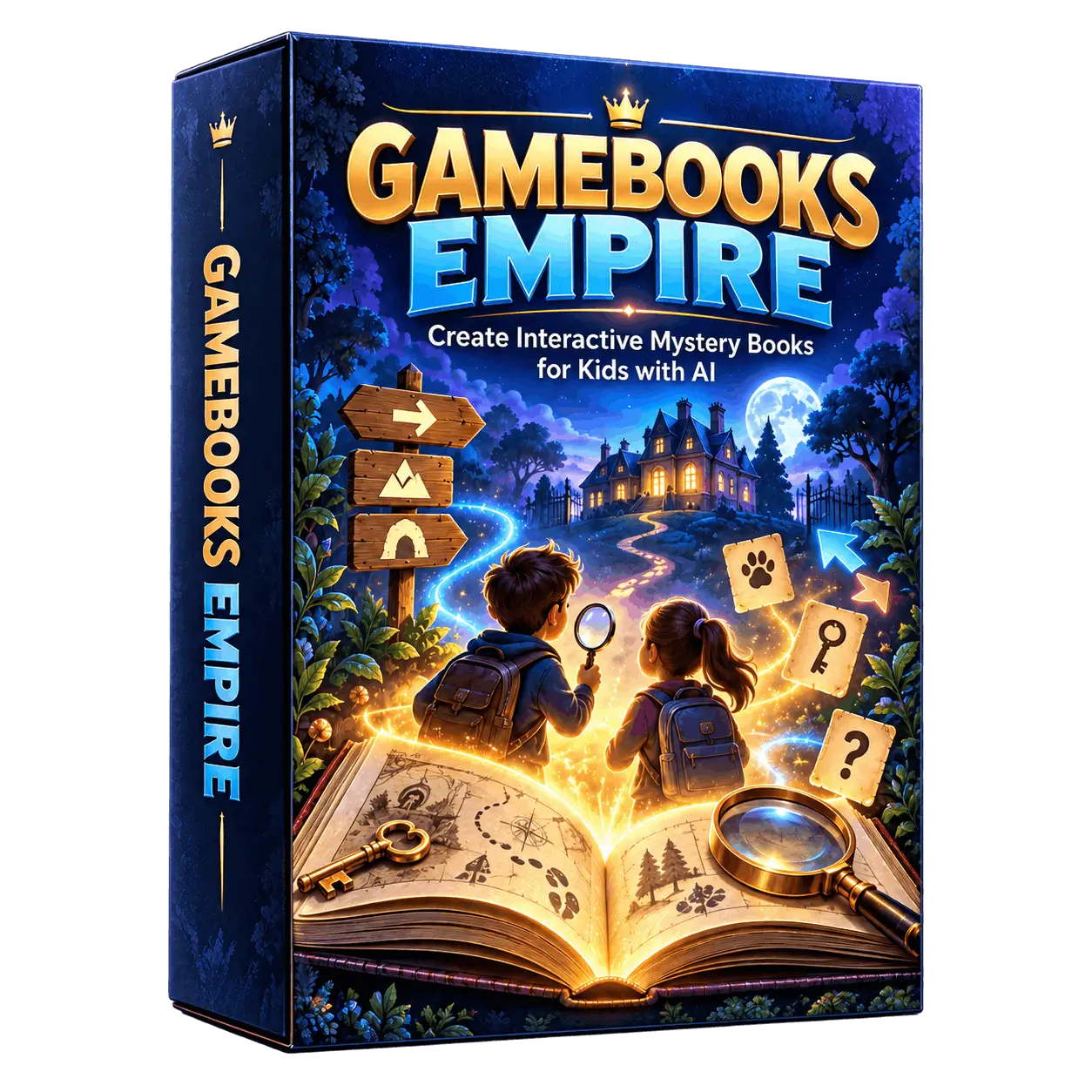
Interactive books bring something to the table that ordinary children’s stories cannot easily match: the reader gets involved.
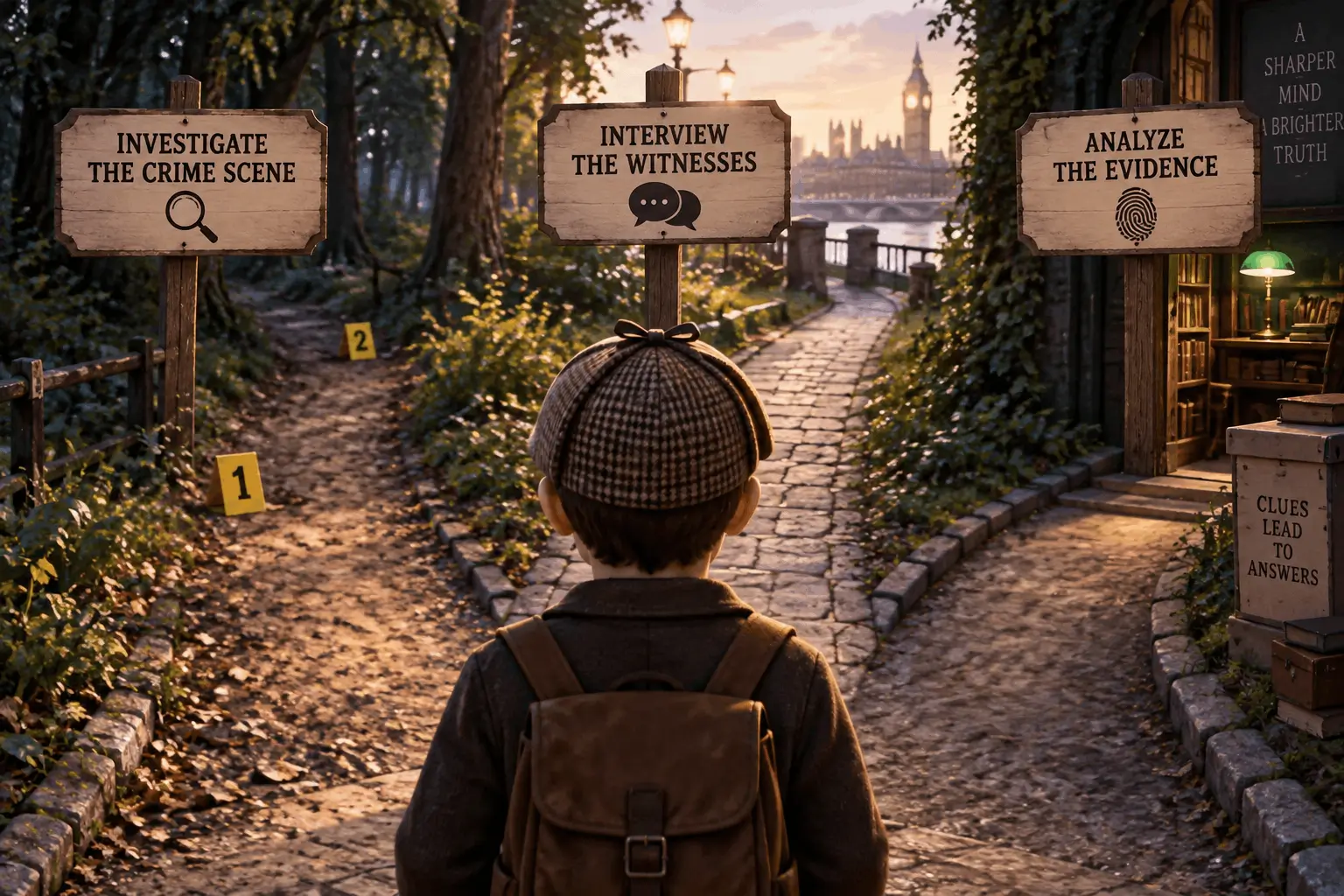
A child does not simply follow the plot from beginning to end. They investigate, make decisions, discover clues, choose different paths, and eventually reach an outcome influenced by those decisions. That replayable structure can turn one book into an experience kids want to explore several times.
Creating this type of book presents a much bigger challenge for the publisher.
You need a central mystery, several suspects, clues placed across different routes, convincing false leads, dozens of connected sections, logical choices, reachable endings, consistent characters, and a solution that still makes sense regardless of the reader’s route.
A normal AI prompt can certainly write a story. Keeping an entire branching gamebook logically connected across 40, 60, or even 100 sections is another problem entirely.
GameBooks Empire tackles that specific challenge with a structured AI workflow designed to produce replayable mystery gamebooks for children aged 8–12.
In this GameBooks Empire review, I’m going to break down what you actually get, how its six-phase creation process works, what makes its clue system interesting, its commercial possibilities, pricing, upgrades, pros and cons, and the type of publisher who can gain the most value from it.
GameBooks Empire Review – Quick Overview

| Creator | Alessandro Zamboni et al. |
| Product | GameBooks Empire |
| Sales page | >>Click Here To Read More |
| Front-end price | $17 (one-time payment) |
| Product Type | AI Mega-Prompt / Interactive Gamebook Creation System |
| Commercial Rights | Yes |
| Bonus | Yes, Huge Bonus |
| Guarantee | 14-day money-back guarantee! |
| Support | Vendor Support: mailto: puck82@gmail.com
HudaReview Support: mailto: hudareviewbonus@gmail.com |
What Is GameBooks Empire?
GameBooks Empire is an AI-powered gamebook creation system that helps you turn a simple idea into a complete, replayable mystery book for kids aged 8–12.
Using a structured mega prompt with popular AI platforms such as ChatGPT, Claude, Gemini, Grok, or DeepSeek, the AI is guided to create branching choices, clue-based investigations, multiple endings, and a finished book ready for publication.
Rather than manually planning dozens of connected story paths, you can use GameBooks Empire to handle the core gamebook structure while you review, customize, and polish the final result.
It is especially useful for KDP publishers, digital product creators, teachers, and anyone interested in creating interactive children’s books with commercial potential.
Who Created GameBooks Empire?

GameBooks Empire was created by Alessandro Zamboni, a digital product creator operating through Internet Marketing Italy.
He has been involved in the digital product business for many years and has developed a range of resources focused on online publishing, AI-assisted content creation, prompts, and practical tools for digital entrepreneurs.
With GameBooks Empire, Alessandro applies that experience to the interactive publishing market, giving creators a structured way to produce branching mystery gamebooks with AI while keeping the process manageable from the initial concept through to the finished book.
Why Creating A Gamebook Is Much Harder Than Writing A Normal Story
The real value of GameBooks Empire becomes clearer once you look at what goes into a functional gamebook.
A traditional children’s story follows a mostly linear sequence: Beginning → Development → Climax → Ending.
Interactive fiction can quickly turn into something closer to this: Opening → Choice A / B / C → More Choices → Rejoining Routes → Clues → Wrong Turns → New Locations → Accusation → Multiple Endings.
One change in an early section can create problems much later.
- A clue may become impossible to discover.
- A character can appear before the reader has met them.
- Two paths may create contradictory information.
- A section can accidentally point toward a number that does not exist.
- One branch might trap the player inside an endless loop.
The reader could even reach the best ending without collecting the evidence needed to justify it.
That structural workload explains why asking AI to simply “write me a choose-your-own-adventure story” often produces an impressive opening followed by increasingly messy logic.
GameBooks Empire handles planning first and delays the full writing stage until the core mystery and route structure are in place.
That design decision makes much more sense for long interactive fiction.

GameBooks Empire Features And What You Get
[+] One Structured Mega Prompt
The core product revolves around one main mega prompt.
You can copy it into your preferred compatible AI and let the instructions guide the model through the book-building process.
This also means GameBooks Empire does not lock you into another monthly AI platform.
You can work with an AI service you already use.
Supported options include:
- ChatGPT.
- Claude.
- Gemini.
- Grok.
- DeepSeek.
- Other comparable AI systems.
The prompt acts as the framework while your chosen AI handles the actual generation.
[+] Six-Phase Book Creation System:
GameBooks Empire breaks the project into six major phases: Concept → Case Bible → Flow Map → Writing → Endings → Book Extras.
You move through the workflow step by step instead of requesting thousands of words at once.
This staged approach gives the AI a stronger reference structure and gives you opportunities to review important decisions before the entire manuscript has already been generated.
I consider this one of the strongest parts of the offer.
Long AI conversations tend to lose coherence when too many characters, routes, facts, clues, and conditions accumulate. Breaking a gamebook into planned stages helps reduce that problem considerably.
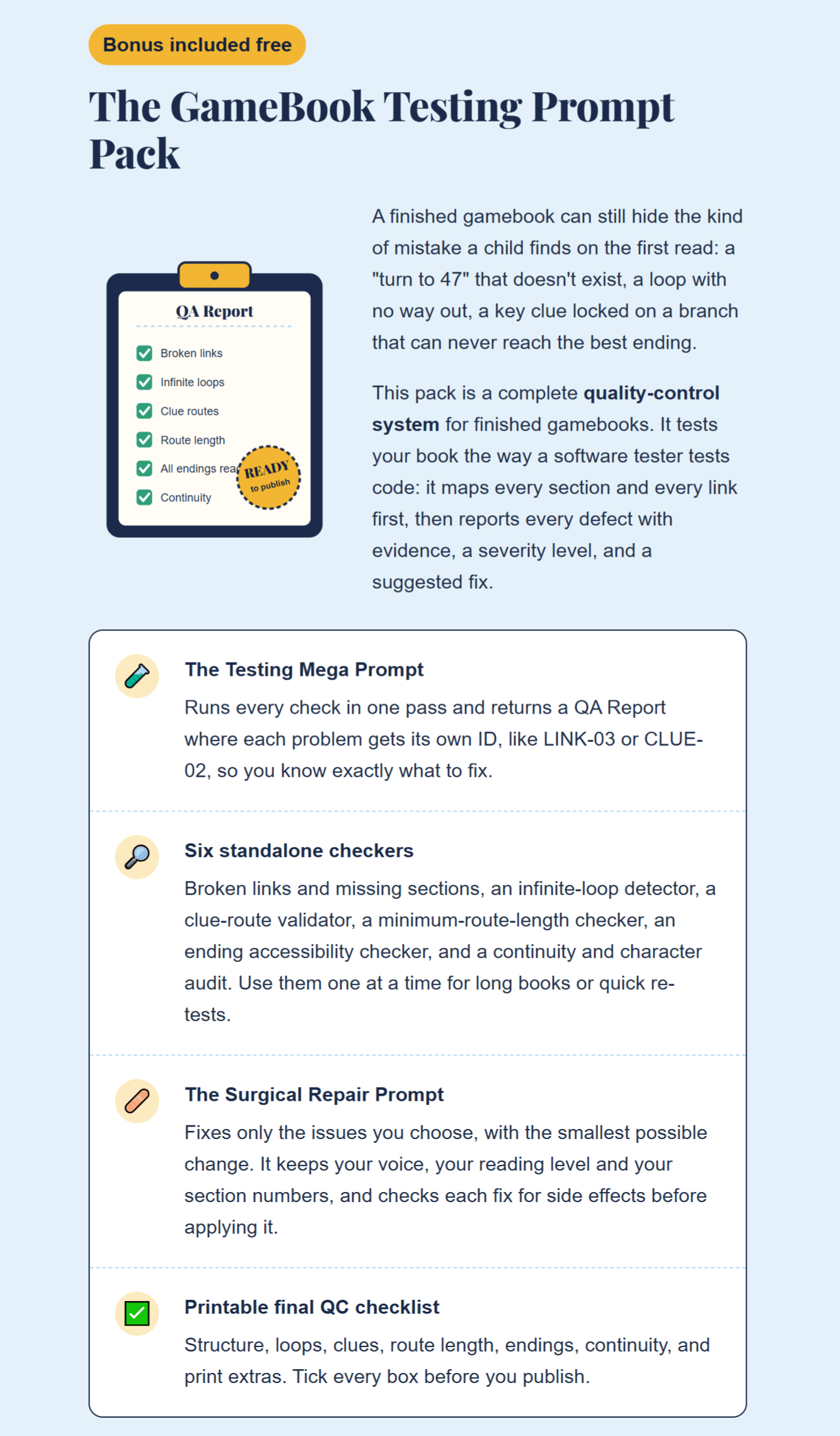
Special Bonus From The Author:
How Does GameBooks Empire Work?
Let’s walk through the full process.
Phase 1: Create The Concept.
The AI begins by creating three possible mystery concepts.
Each pitch can contain elements such as:
- Title.
- Main hook.
- Mystery or puzzle.
- Setting.
- Sidekick.
- Reason the concept may appeal to ages 8–12.
Choose the idea you prefer and move forward.
You can also request more concepts when the first three do not match your direction.
This gives you creative control without forcing you to develop the complete premise manually.
Phase 2: Generate The Private Case Bible.
Next comes one of the most important stages: the Case Bible.
This document contains the hidden logic behind the mystery.
The AI establishes:
- What really happened.
- The culprit.
- Motive.
- Method.
- Timeline.
- Four suspects.
- Six genuine clues.
- Two false clues.
- Key locations.
The reader never sees this private planning document.
It serves as the AI’s internal reference throughout the creation process.
A strong Case Bible gives the story a foundation. Characters, clues, motives, and events already have defined relationships before the branching narrative expands.
Phase 3: Map Every Route.
Now the AI produces the Flow Map.
Every section receives a number, a short summary, and connections leading toward other sections.
GameBooks Empire then checks several structural conditions, including:
- Every section can actually be reached.
- Routes do not create infinite loops.
- Key clues remain obtainable.
- More than one viable route can reach the best ending.
- The reader cannot force an early confession.
- Branches reconnect logically.
Section numbers can also appear in a shuffled order, helping prevent readers from simply reading the pages sequentially and accidentally spoiling the mystery.
This is a major distinction between a structured gamebook system and generic AI storytelling.
The book needs a working map before it needs beautiful prose.
Phase 4: Write The Story.
Once the structure checks out, the AI begins writing the actual gamebook.
It creates sections in batches of ten, using kid-friendly language and maintaining a continuity log after each group.
The writing style targets younger readers with:
- Short sentences.
- Familiar vocabulary.
- Clear actions.
- Straightforward descriptions.
- One major idea at a time.
Each section can end with two or three choices.
For example, a reader may investigate the kitchen, question a suspect, or visit another location. Every decision redirects them toward another numbered section.
The default system targets around 120–220 words per section and roughly 60 sections per book, although you can adjust the size from around 40 to 100 sections.
Phase 5: Create Three Meaningful Endings.
GameBooks Empire does more than attach three random conclusions to the final pages.
Its endings connect directly with the clue system.
♦ Best Ending:
The reader discovers all three key clues.
They solve the case successfully, and the conclusion explains the evidence and reasoning step by step.
♦ Partial Ending:
The reader finds one or two key clues.
They may reach the correct conclusion, but their evidence remains incomplete. The story encourages another attempt.
♦ Cold Case Ending:
The reader reaches the accusation without enough important evidence or relies on a false clue as proof.
The case remains unresolved in a light, child-friendly way, followed by a Detective’s Tip that encourages another playthrough.
This mechanic gives earlier choices a purpose.
The ending reflects what the reader actually discovered during the investigation.
A Fair-Play Mystery System
GameBooks Empire uses a planned clue structure containing:
- 6 true clues
- 2 false clues
- 3 key clues among the six true clues
The AI places this evidence throughout the branching routes before completing the story.
That approach creates a fairer mystery.
Children have the opportunity to discover the evidence needed to solve the case, rather than encountering a culprit arbitrarily chosen at the end.
False clues add another layer because readers must decide which information actually supports their theory.
The three-ending structure then scores the investigation according to the evidence collected.
This turns the book into more than a branching story. It introduces a light game mechanic where exploration affects the final result.
Kid-Friendly Mystery Content
GameBooks Empire targets readers aged 8 to 12. The system therefore keeps the mysteries gentle.
Wrong decisions may waste time, send the reader toward a funny dead end, or cause them to miss useful evidence. The standard framework avoids weapons, injuries, serious danger, and adult-style motives.
You can also adjust the atmosphere through three general levels: None → Mild → Cozy-Spooky.
That range gives creators room to produce cheerful mysteries, slightly mysterious adventures, or gentle spooky stories without moving into darker material unsuitable for the intended age group.
Book Extras Are Included Too
Finishing the final mystery does not end the workflow.
GameBooks Empire can also generate supporting material for the book, including:
👉 How To Play Page:
A short explanation showing young readers how the gamebook works.
👉 Detective Notebook:
A printable activity area containing elements such as:
- Clue checklist.
- Suspect notes.
- “My Theory” section.
👉 Alternative Book Titles:
Useful when you want more publishing or series-name options.
👉 Back-Cover Blurb:
Marketing copy you can refine for the physical book.
👉 Online Store Description:
A starting point for product listings.
👉 Cover Prompts:
Generate prompts for front and back cover concepts.
👉 Illustration Prompts:
Create ideas for full-color images or coloring-page-style artwork through compatible image-generation tools.
These extras help move the project closer to a marketable publishing asset instead of leaving you with only the manuscript.
Turn A Finished Mystery Into A Series
A single successful character can also become the foundation for future books.
Complete book one, provide it as context to the AI, then run the system again with the same main character and a fresh mystery.
That opens the door to a recognizable children’s detective series.
For publishers, a series can make more sense than releasing unrelated standalone titles. A single character, visual identity, or setting can connect multiple gamebooks and give readers another title to explore after finishing the first.
Can You Make Money With GameBooks Empire?
GameBooks Empire gives you commercial rights to the books you generate.
According to the product terms, you can publish under your own name or a pen name, create unlimited titles, and keep the revenue generated from those books.
Potential publishing channels include:
- Amazon KDP.
- Etsy.
- Teachers Pay Teachers.
- Gumroad.
- Shopify.
- Your own website.
- Printable book bundles.
- Classroom resources.
- Client projects.
- Lead magnets.
- Bonuses for other products.
The restriction applies to the underlying GameBooks Empire materials themselves. You can commercialize the books created from the system, but you cannot resell or redistribute the original mega prompt and guide.
This creates an interesting digital-publishing angle.
One workflow can produce many different themes, settings, characters, mysteries, and series concepts without manually rebuilding the branching structure every time.
Still, creation does not guarantee sales.
Book quality, cover design, niche research, keyword selection, pricing, listing optimization, promotion, and overall presentation remain important parts of the publishing business.
Important Note For Amazon KDP Publishers
Anyone planning to use GameBooks Empire for Amazon KDP should pay attention to Amazon’s current AI-content policy.
Amazon currently requires publishers to disclose AI-generated text, images, or translations during the KDP publishing process. Content created by an AI tool still counts as AI-generated even after substantial manual editing.
Amazon treats AI-assisted work differently. Content you created yourself and only used AI to edit, refine, brainstorm, or check does not require the same disclosure.
Publishers also remain responsible for intellectual-property compliance and overall content quality.
GameBooks Empire can help with creation and structural QA, but you still control the final publication and need to follow the rules of each marketplace you use.
GameBooks Empire Pricing
The GameBooks Empire front-end currently costs $17 as a one-time payment. There is no recurring fee attached to the core package itself.
Your main AI platform may have its own usage costs or a subscription fee, depending on the service and plan you choose.
For the $17 front-end, you receive the core creation system including:
- GameBooks Empire mega prompt.
- Plain-English usage guide.
- Six-phase book architecture.
- Mystery and clue framework.
- Three-ending system.
- Book extras.
- Publishing and formatting instructions.
- Cover and illustration prompts.
- Commercial rights for generated books.
- GameBook Testing Prompt Pack.
The offer also includes a 14-day money-back guarantee. The product documentation states that you can generate and evaluate a real book, and then contact the vendor during that period if the system does not meet your expectations.

At this price point, I think the strongest value comes from the architecture and testing process, not simply the ability to generate words.
Almost any modern AI can create text.
Getting dozens of interconnected sections, clue dependencies, multiple endings, and navigational routes to work together presents the harder problem.

GameBooks Empire Review – The OTOs And Upgrades
The current funnel also includes optional genre expansions. Recent launch information lists the following upgrades:
OTO 1: Sci-Fi GameBooks Empire
Price: $27 (one-time payment)
This expansion shifts the gamebook framework toward child-friendly science-fiction mysteries set in space stations, on planets, and in other futuristic environments, featuring robots.
It keeps the branching investigation format while giving publishers another genre to target.
OTO 2: Fantasy GameBooks Empire
Price: $37 (one-time payment)
This package moves the concept into the realm of fantasy.
Possible settings include magical forests, talking animals, mysterious castles, and other fantasy-driven environments while retaining branching choices and clue-based endings.
OTO 3: Time-Travel GameBooks Empire
Price: $37 (one-time payment)
This version combines interactive mystery storytelling with historical settings.
Readers can move through different periods while investigating cases, creating potential uses for educational publishers, homeschool material creators, teachers, and regular gamebook sellers.
OTO 4: Adventure GameBooks Empire
Price: $47 (one-time payment)
Adventure GameBooks Empire expands the concept into classic adventure settings, including islands, jungles, treasure hunts, caves, and exploration.
It provides another publishing direction for creators who want something beyond the central mystery theme.
OTO 5: Cozy Halloween + Christmas GameBooks Empire
Price: $67 (one-time payment)
The final listed upgrade contains two seasonal gamebook engines.
One focuses on gentle Halloween-style mysteries, while the other produces Christmas-themed adventures.
Seasonal publishers may find this useful for building titles around holiday shopping periods.
Who Is GameBooks Empire For?
GameBooks Empire makes the most sense for:
✅ KDP Publishers:
You can use the workflow to create interactive children’s paperback or ebook concepts without manually plotting dozens of branching sections.
✅ Etsy And Printable Sellers:
The stories, Detective Notebook pages, and interactive format can be easily converted into downloadable printables.
✅ Teachers And Educational Creators:
Mysteries can encourage reading comprehension, attention to detail, logical thinking, and decision-making.
✅ Digital Product Sellers:
Gamebooks can become standalone products, themed bundles, membership content, or supporting bonuses.
✅ Parents:
Parents can create personalized mystery adventures based around themes their children enjoy.
✅ Freelancers And Publishing Agencies:
Commercial rights also create room for producing custom gamebook projects for clients.
✅ Children’s Content Creators:
Existing characters or brand concepts can potentially expand into interactive story experiences.
Who May Not Need It?
GameBooks Empire will make less sense to people searching for a fully finished book that requires no review or editing.
You still need to supervise the AI.
Good publishing requires checking the manuscript, strengthening weak passages, verifying the logic, reviewing artwork, testing the routes, and properly preparing the final product.
The system also concentrates heavily on gentle mystery gamebooks for ages 8–12.
Creators primarily interested in mature thrillers, violent fiction, adult horror, or traditional linear novels will find other tools more suitable.
Finally, this is a prompt-driven creation framework rather than a cloud app with buttons, project dashboards, or automated marketplace publishing.
Understanding that distinction before purchasing prevents the wrong expectations.
Pros and Cons
Pros:
✅ Highly structured creation process:
The six-phase workflow tackles the hardest parts of interactive storytelling before expanding the manuscript.
✅ Meaningful replayability:
Three endings respond to the clues readers actually discover.
✅ Strong mystery architecture:
The Case Bible, clue system, route mapping, and ending logic provide the AI with more context than a generic story prompt.
✅ Dedicated gamebook testing tools:
Broken links, unreachable endings, loops, and continuity mistakes can ruin an interactive book. The QA pack directly addresses those issues.
✅ Works with several major AI platforms:
You can use ChatGPT, Claude, Gemini, Grok, DeepSeek, and other similar models.
✅ Adjustable projects:
Change the theme, setting, sidekick, spooky level, book length, and other creative elements.
✅ Commercial rights:
You can sell the generated books under your own brand or pen name and create unlimited projects.
✅ Publishing extras included:
The workflow can also prepare blurbs, store descriptions, Detective Notebook pages, cover concepts, and illustration prompts.
✅ Low front-end entry price:
The current $17 one-time cost keeps the initial investment relatively small.
Cons:
❌ You still need an AI platform:
GameBooks Empire supplies the framework and prompts. The actual generation runs through ChatGPT, Claude, Gemini, or another supported AI.
❌ Human editing remains necessary:
A testing prompt can catch structural issues, but it cannot guarantee perfect prose, attractive humor, factual accuracy, or flawless storytelling.
❌ Long books still require attention:
A 60-section interactive mystery contains many moving parts. Reviewing the route map and final manuscript takes time.
❌ It does not generate buyers:
The system helps you create the product. Marketing, cover quality, keyword research, pricing, positioning, and traffic still influence sales.
My Own Thoughts About GameBooks Empire
The most interesting thing about GameBooks Empire is not that it lets AI write children’s stories.
We already have plenty of AI tools capable of doing that.
Its real value appears in the logic surrounding the story.
Interactive fiction becomes difficult once choices start affecting future sections. Writers need to know what the reader has discovered, which characters they have met, which locations remain available, which clues belong to which routes, and what conditions justify each ending.
GameBooks Empire addresses that complexity with the Case Bible, Flow Map, clue architecture, continuity logging, scored conclusions, and testing prompts.
That makes the concept much more practical than throwing a short command into ChatGPT and expecting a polished gamebook to appear.
I also like the commercial flexibility.
A publisher could create a detective series, produce printable classroom mysteries, experiment with seasonal editions, develop custom books for clients, or turn successful characters into recurring titles.
The GameBook Testing Prompt Pack may be one of the strongest components because structural mistakes have a much bigger impact in interactive fiction than in standard books. One incorrect section number can break an entire route.
Still, I would never recommend publishing raw AI output.
The smartest approach is to use GameBooks Empire as the creation engine while you remain the editor and publisher. Review the logic, improve the writing, inspect every choice, test several routes, refine the artwork, and make the finished product genuinely enjoyable for children.
That combination gives the concept much stronger long-term potential.
GameBooks Empire Review – Final Conclusion
GameBooks Empire offers a practical way to create interactive mystery gamebooks without having to manually plan every branch, clue, and ending from scratch. Its structured prompt system, clue-based logic, multiple endings, and testing tools make the process much more manageable, especially for KDP publishers, digital product sellers, teachers, and creators entering the children’s publishing market.
For me, the strongest value lies in the combination of AI-powered creation, replayable story structure, commercial rights, and quality-control prompts. At its low one-time price, GameBooks Empire gives you a solid framework to start creating original gamebooks while still keeping full control over the final product.
GameBooks Empire FAQ
What exactly do I receive with GameBooks Empire?
You receive the main GameBooks Empire mega prompt, a plain-English guide, its six-phase creation framework, publishing and formatting instructions, cover and illustration prompts, commercial rights for generated books, and the GameBook Testing Prompt Pack.
Is GameBooks Empire software?
No. It is primarily a structured mega-prompt and guide system that you run through a compatible AI platform.
Which AI platforms work with it?
The system supports ChatGPT, Claude, Gemini, Grok, DeepSeek, and other comparable AI models.
What age group does it target?
The core mystery framework targets children aged approximately 8–12.
How long are the books?
The default setup produces around 60 sections, generally containing roughly 120–220 words each. You can adjust the section count to approximately 40–100.
How many endings can a book have?
The standard system produces three outcomes: a best ending, a partial ending, and a cold-case ending.
How do the endings work?
The result depends on the reader’s investigation. Three key clues lead to the strongest solution; fewer clues yield a partial outcome, while insufficient or misleading evidence can result in a cold-case conclusion.
Can readers replay the books?
Yes. Different choices can lead toward different routes and clues, giving readers a reason to restart the investigation and seek a better result.
Does it create illustrations?
The package provides prompts for covers, full-color artwork, and coloring-page-style illustrations. You run those prompts through a suitable image-generation system.
Can I create a book series?
Yes. A finished book can provide context for the next project, allowing you to retain the same central character while creating a fresh mystery.
Can I sell the books?
Yes. The product includes commercial rights for the gamebooks you generate. You can publish under your own name or pen name and retain your sales revenue.
Can I resell the GameBooks Empire mega prompt?
No. Commercial rights cover the books you create, not the original prompt system or guide.
Where can I sell the finished books?
Potential channels include Amazon KDP, Etsy, Teachers Pay Teachers, Gumroad, Shopify, your own website, and other suitable marketplaces.
Do I need to disclose AI-generated books on Amazon KDP?
Amazon currently requires disclosure of AI-generated text, images, and translations during the publishing process. Publishers remain responsible for ensuring their books comply with KDP content and intellectual-property policies.
Does GameBooks Empire guarantee sales?
No. It provides a system for creating the product. Sales still depend on factors such as niche selection, quality, presentation, pricing, keywords, promotion, and audience demand.




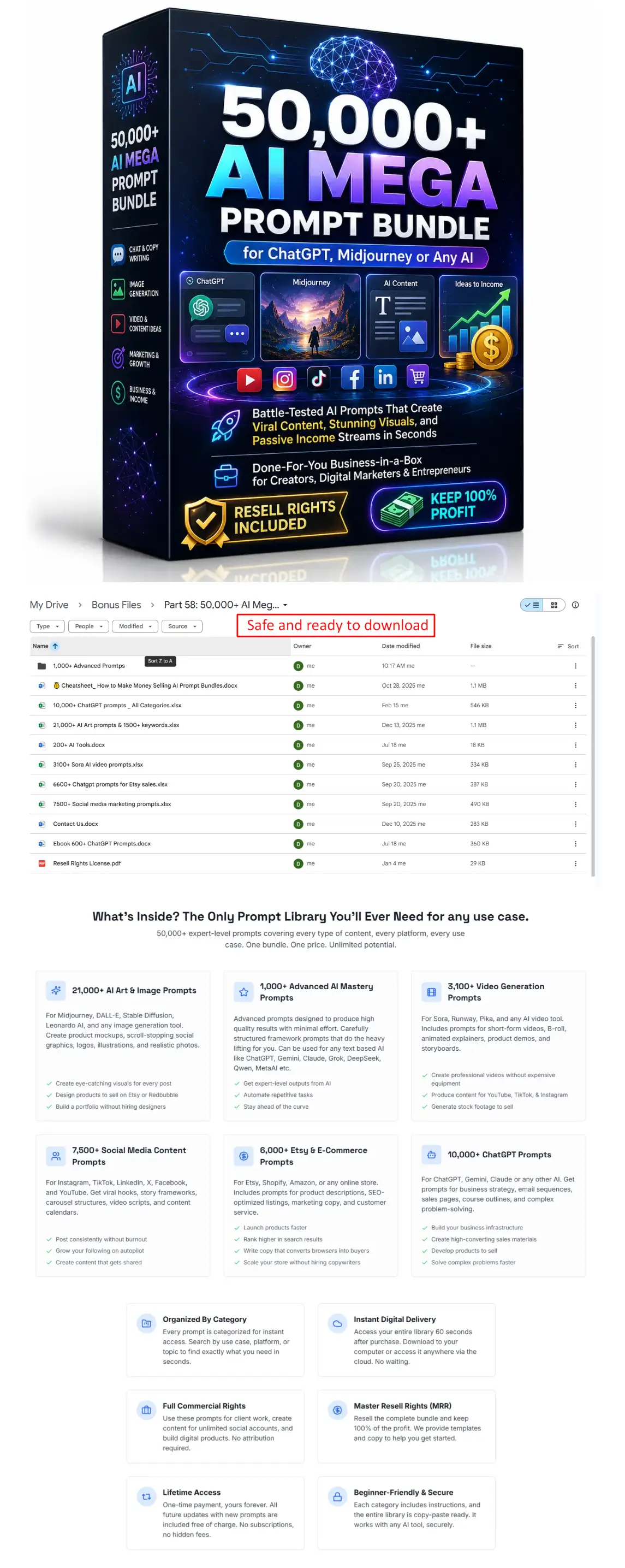
50,000+ AI Mega Prompt Bundle for ChatGPT, Midjourney, or Any AI
The Elite Agency Launchpad

The Training & Resources To Start Working In KDP Publishing
Part 1:

Part 2:


The Ultimate Collection of High-Quality PLR Packages For Your Online Business

01st Mega Pack:
10 Beautiful Themes For Different Business Types

02nd Mega Pack:
Graphics Elements For Versatile Usage

03rd Mega Pack:
The Video Tools

04th Mega Pack:
The Social Media Marketing Suite

05th Mega Pack:
The Social Traffic Apps

06th Mega Pack:
The Health, Diet, and Lifestyle Ebooks With PLR

07th Mega Pack:
The PLR Products With Personal Development Content

***3 STEPS TO CLAIM THESE BONUSES***
Step 1: Buy the GameBooks Empire on my website:

Step 2: After completing the transaction, forward the receipt to my email at hudareviewbonus@gmail.com
Final step: You will receive the bonuses within 24 hours.
Thank you again for reading my GameBooks Empire review. Send my best wishes to you and your family.